Mad honey is expensive because authentic jars come from wild Himalayan cliff hives, are cut by hand during a short harvest season, and must be tested and shipped from remote villages before they reach a buyer.
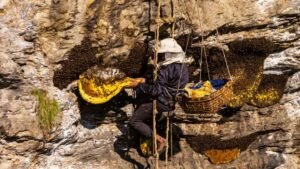
Hunters climb hand-woven rope ladders up sheer rock faces to reach hives of the giant Himalayan honeybee, which gathers rhododendron nectar that carries grayanotoxins into the honey. That single detail separates mad honey from ordinary shelf honey and sets up every cost explained below.
Price has also moved with attention. Social media clips and documentaries have put cliff hunting in front of millions of viewers, and growing interest in traditional Himalayan wellness practices means more buyers chase a supply that nature will not expand. The sections ahead take each cost driver in turn, then show how to judge a price.
Authentic mad honey generally costs between $20 and $85 per 100g, or roughly $150–$350 per kilogram, according to one specialist mad honey guide.
That guide says verified 250g jars mostly land between $65 and $155. A U.S. retail guide puts authentic Himalayan 250-gram jars at $60 to $200 and Turkish lots at $30 to $80. The sources disagree on exact figures, so treat every range as approximate and check the seller’s batch details.
|
Origin |
Typical 250 g price |
Notes |
|---|---|---|
|
Nepal, premium cliff lot |
$150–$250+ |
Wild harvest from a named region |
|
Nepal, standard |
$60–$150 |
Most of the legitimate market |
|
Nepal (specialist guide) |
$75–$110 |
Smaller, more traceable harvests |
|
Turkish mad honey |
$30–$80 |
Milder, from managed hives |
|
Anything under $25 |
Treat as suspect |
Usually dyed or mixed honey |
These are retail ranges, and a poor bloom in Nepal pushes the following year’s prices up noticeably.
Harvesting wild mad honey is a physically dangerous job, and that risk is priced into every jar.
Hunters first cover mountain trails with no roads, sometimes for days, carrying ropes and baskets toward high mountain cliffs where colonies of Apis laboriosa hang hundreds of feet above the ground. Traditional harvesting methods then send a lead hunter down a rope-ladder while thousands of wild bees circle him.
Strong winds or rain can delay or cancel the climb, and a missed opening can mean waiting several months, because the harvesting period lasts only a few weeks. Only certain people are selected for the work, and one specialist guide names rare single-season reserve batches above 4,000m as the most expensive harvest. Each jar therefore carries travel, preparation and risk, not just honey.
The main mad honey harvest falls in one short stretch of the year, so supply is capped by the calendar, not by what buyers want.
The flowers that feed the bees bloom briefly, and availability drops to zero once they fade, until the next bloom. A smaller second harvest appears in some regions but is far less predictable. Because the wild bee species and the mountain ecosystem both depend on that bloom, producers cannot shift the schedule.
Smaller harvests follow a weak bloom, and the effect shows up in retail prices, as one 2026 guide notes for Nepal. When you compare jars from the same general region, the ultra-premium cliff lots from a named district such as Lamjung cost the most, because each season’s output is limited.
Mad honey depends on the largest honeybee on Earth, which nests only on remote cliffs and cannot be kept in managed hives.
These bees attach their combs to rock overhangs, with wild harvests typically coming from above 3,500 meters. Unlike commercial honey bees housed in ordinary beehives, they cannot be moved, multiplied or farmed on demand.
That biology fixes a hard ceiling on output. Flowering and cliff access decide each year’s volume, while producers using managed apiaries, as with most Turkish mad honey, see a larger and more consistent supply. Ordinary honey production does not face that limit, which is why wild cliff output stays small however many buyers arrive.
Yes, lab tests raise the price, because responsible sellers send every batch for grayanotoxin testing before it is sold.
Testing also protects buyers. Grayanotoxin levels vary between batches, which is why pregnant or breastfeeding people, children and anyone on heart medication are told to avoid mad honey. Cutting tests is one of the most common ways sellers shave costs, according to one specialist guide.
Wider quality control adds more: careful handling, sturdy glass jars and compliance with import regulations. Because mad honey cannot be mass-produced, those fixed costs are spread over few jars. One Himalayan honey source adds that transparency has limits, since many small remote producers cannot afford regular laboratory analysis.
Shipping and import costs add meaningful money to every jar, because the honey travels from remote Himalayan villages to buyers on other continents.
After the honey is carried out of the hills, it is processed, packed and sent abroad, so a buyer pays for shipping costs, taxes and food-import compliance. One Himalayan honey source notes that the same product can cost less in Nepal than in the United States, Europe or Australia for exactly these reasons. One specialist guide puts Nepalese 250 g jars at $75 to $110, often $90 to $110 with shipping.
Repackagers in the U.S. and EU frequently import Nepalese or Turkish stock and resell it marked up, at roughly $77 to $155+ for 100g to 250g. That means extra handling cost lands on the shelf price before the honey reaches a shopper.
Yes, demand has outgrown supply, and that gap keeps prices firm or rising.
Supply stays capped because the cliffs, the bees and the wild harvests do not change when more people want honey. The rarity here comes from geography, season and bee biology, not from artificial scarcity, so extra buyers simply compete for the same limited jars.
First-time buyers often compare the price with honey from supermarkets and are surprised. Yet part of the premium pays the labor of hunters and supports the livelihood of communities whose skills pass down through generations.
High prices also tempt bad actors. Marketplace listings with no company behind them are where most fakes live, according to one U.S. retail guide, and some jars are mislabeled about their true origin.
Harvest altitude, season and batch rarity set most of a jar’s price, while testing, brand standing and transport add smaller shares.
A spring harvest tied to the rhododendron bloom is usually the most sought after, per one Himalayan honey source, and tougher cliffs raise the price further. Transport matters too: export documents, customs, import duties and insurance all land on the final bill, along with packaging standards that keep glass jars intact.
|
Jar size |
Typical price |
Best for |
|---|---|---|
|
250 g |
$65–$155 |
Regular users wanting a few months’ supply |
|
500g |
$120–$240 |
Households sharing one jar, lower unit cost |
|
1kg |
$150–$350+ |
Wholesale buyers, gifting or bulk use |
Larger jars cost more in total, yet the price per gram usually falls, though not in a straight line. A half-kilo jar of true wild honey rarely costs half as much as the biggest jar, because bigger batches are harder to source from one hunt. One U.S. retail guide adds that a 1-kilogram jar offered for $80 is not what it claims to be.
Nepalese mad honey costs more mainly because it is wild-collected from remote, high-altitude cliffs in small seasonal batches, while most Turkish mad honey comes from managed, ground-level hives.
One specialist guide says Turkish jars are often priced 15–30% below Nepalese ones of similar size. One U.S. retail guide lists Turkish deli bal from managed hives in the Black Sea region at a milder, lower price band. Nepal’s cliff hives sit at roughly 2,500–4,000 meters, well above those apiaries.
Skilled communities: The Gurung, Magar and Chhetri hunters climb rope ladders by hand, a slower and riskier method than beekeeping.
Cliff tools and teamwork: Hunters use ladders and bamboo poles, and the work depends on teamwork and days of trekking to reach the hives.
Tiny yields: Wild colonies produce far less honey per hunt than managed hives.
Traceability: Reputable Nepalese producers link jars to a harvest region and season, which is harder where honey is mixed across sources.
No, a higher price does not guarantee better mad honey, because price and quality track each other only loosely in this market.
Honey blended with ordinary honey can still be marketed as premium, and one 2026 guide says very cheap jars are often ordinary honey with caramel coloring. A high price tag therefore screens out nothing by itself.
Better evidence is a batch-specific lab report showing purity and grayanotoxin levels, plus batch numbers or QR codes that trace a jar to its harvest. Sellers who work directly with named honey-hunting communities tend to run steadier quality checks, whatever they charge. A trustworthy brand reputation, a clear country of origin and responsive customer service matter too. In my own checks, I read the lab report before the price tag.
The most reliable way to avoid fake or overpriced mad honey is to check the price against the market, the stated origin, the test results and the ingredients before paying.
Dishonest sellers exploit rising demand by passing off ordinary honey as mad honey, according to one Himalayan honey source. Prices far below the market average often point to diluted or mixed jars, and one specialist guide says genuine mad honey sits well above $20 per 100g.
Vague origin: “Himalayan” covers five countries, so a seller should name a district such as Rukum or Jajarkot.
No testing: Reputable importers test for grayanotoxin potency, or at least adulteration and contaminants, and publish the results.
Unclear ingredients: Authentic mad honey should contain honey only, with no added glucose syrup or corn syrup, so read the ingredient list.
Unrealistic promises: Guaranteed or dramatic effects are claims real wild honey cannot deliver.
Read reviews on independent platforms rather than testimonials on the seller’s own site, and ask for harvest details before ordering.
Mad honey is worth the price for buyers who want a rare, tested honey, but not for anyone looking for a cheap honey substitute.
Price is one signal among several, and a wooden gift box or other branding markup can add cost without changing the contents. A $110 jar with no batch information is a worse bet than a $70 jar with a public test result tied to its harvest, as one specialist guide points out.
Demand has also been pushed by rising awareness among travelers and online viewers, and one U.S. retail guide says U.S. interest has grown sharply since 2020. Compare jars by net weight, not just sticker price, and treat a missing batch trace as a red flag. A jar with no bitter note or throat tingle suggests ordinary honey, according to one U.S. retail guide.
Brands charge different prices because their testing, batch tracking, packaging and the way they pay honey hunters all differ, even for honey from one area.
Cleaning and filtering to remove beeswax, plus hygiene routines and lab checks of moisture level, add cost. Raw jars also keep natural enzymes intact, as one specialist guide notes, and light processing like this still costs money before a jar is filled.
Logistics differ as well: fuel, protection against breakage and spoilage of jars, and presentation all vary. Sellers with real sourcing relationships among named hunting communities, rather than anonymous middlemen, often pay hunters more and charge accordingly, even for honey from the same area.
No, authentic Himalayan mad honey cannot be farmed, because the wild bees that make it have never been domesticated.
Unlike bees kept in wooden boxes, these colonies build on cliffs, so no commercial apiary can scale up production. Their output follows the rhododendron bloom cycle: the main harvest falls between March and May, with a smaller, less predictable autumn harvest in some regions, so honey is cut once or twice a year.
Once the window closes, hunters wait months for the next bloom, and responsible hunters leave part of each hive intact so the colony recovers, trimming yield further. That is the core reason supply cannot be expanded on demand.
A 250 g jar of raw mad honey holds around 35 servings at one teaspoon, roughly 7 grams, per serving, according to one U.S. retail guide.
At $60 a jar, that works out to about $1.70 a serving; at $150 it is about $4.30, and premium lots run $6 or more. At one serving a few nights a week, a jar stretches to nearly three months by my own arithmetic, while near-daily use cuts that to a month or two.
The catch is variability: the dose in a teaspoon varies with the batch, so some servings feel like nothing and others like too much. That is why small dosing and a measured start make sense, and why the jar is better treated as a specialty product, used occasionally like a good wine, than as an everyday sweetener.
A first-time user should start with half a teaspoon and wait at least a full day before taking more, because grayanotoxin strength changes from one batch to the next and no two jars behave the same. A full teaspoon is the commonly mentioned serving, roughly 7 grams, but that is a general figure, not a dose matched to your body. Take it on a day when you are at home and have nothing demanding planned, and never mix it with alcohol or take it on an empty stomach the first time. If half a teaspoon feels like nothing, do not jump to two or three spoonfuls the next day. Increase slowly over several days, one small step at a time, and stop entirely if you feel dizzy, sick or unusually tired. The point of starting small is simple: a dose that is too strong cannot be taken back once it is swallowed.
Taking too much mad honey can cause grayanotoxin poisoning, and the signs usually appear within a few hours of eating it. The most common symptoms are dizziness, nausea, vomiting, sweating, a drop in blood pressure and a slow heartbeat, and in stronger cases people feel faint or confused. These effects are the reason mad honey is treated as a specialty product rather than an everyday sweetener. If you feel faint, your heartbeat feels unusually slow, or vomiting does not stop, seek medical help right away and tell the doctor exactly what you took and how much. Do not try to sleep it off or wait for it to pass on its own. Most cases settle with medical care, but the risk is real, which is why every responsible seller warns first-time users to start with a small amount.
Mad honey is generally legal to buy and own in the United States, the United Kingdom and most of Europe, because grayanotoxin itself is not a controlled drug in those places. The trouble starts at the border. Some countries treat it as a food product and allow it through normal customs checks, while others seize it as an unapproved or mislabeled import, and the rules can change without warning. A jar that ships freely to one country can be stopped in another, so always check your own country’s food-import rules before ordering from abroad. Buying from a seller inside your own country avoids most of this risk, since that seller has already handled customs and compliance. Never order mad honey while travelling and expect to carry it home without checking, because airport customs officers may confiscate it even when it was legal where you bought it.
Store mad honey in its original sealed glass jar, in a cool, dark cupboard away from sunlight and heat, and always use a clean, dry spoon. Honey does not spoil quickly when it is kept dry and sealed, and a jar can keep for a year or more, but moisture is the enemy: a wet spoon can start fermentation and ruin the whole jar. If the honey turns cloudy or grainy, that is crystallisation, which is normal for raw honey and not a sign that it has gone bad. Warm the sealed jar gently in warm water and stir, and it will turn liquid again. Never microwave it or pour boiling water over it, because high heat damages the natural enzymes that make raw honey different from processed honey. Once opened, keep the lid tight and finish the jar within a few months for the best flavour and strength.
Real mad honey is usually dark, reddish-brown and thicker than supermarket honey, with a strong, earthy smell. The taste is the clearest test: it is noticeably bitter at the back of the tongue and leaves a warm tingle or slight burn in the throat that ordinary honey never gives. A jar that tastes only sweet, with no bitterness and no throat tingle, is almost certainly ordinary honey, however premium its label looks. Colour alone proves nothing, because caramel colouring can fake a dark jar, so taste, smell and thickness must all be checked together. Ask the seller for the harvest region and season, and compare the batch details with the lab report. If the seller cannot tell you where and when the honey was cut, that silence is itself an answer.
Mad honey is not meant for daily use, and treating it like ordinary honey is the fastest way to take too much. Grayanotoxin builds up its effect with repeated use, and the strength of each batch is different, so a daily spoonful can quietly add up to more than your body handles well. Most experienced users take it only a few nights a week, with rest days in between, and they stop for a while if they notice dizziness, unusual tiredness or a racing or slow heartbeat. There is no official daily limit, because no regulator has set one, which is itself a reason for caution. Think of it the way the article already suggests: a specialty product for occasional use, like a good wine, not a sweetener for your morning tea. If you take heart medicine or blood pressure medicine, ask your doctor first, and do not take it at all while pregnant or breastfeeding.
Authentic mad honey generally costs $20 to $85 per 100g, or about $150–$350 per kilogram. Verified 250g jars mostly land between $65 and $155, with premium Nepalese cliff lots at $150–$250 or more. Anything under $25 for 250g should be treated as suspect.
It is expensive because hunters climb rope ladders up sheer cliffs to reach wild hives of the giant Himalayan honeybee, the harvest lasts only a few weeks a year, every batch needs lab testing, and the honey must be shipped from remote villages. Demand keeps rising while nature will not expand the supply.
It can be used carefully by healthy adults in small amounts, but it contains grayanotoxins that affect blood pressure and heart rate. Pregnant or breastfeeding people, children and anyone on heart medication should avoid it. First-time users should start with half a teaspoon and never mix it with alcohol.
Start with half a teaspoon and wait a full day before taking more. A full teaspoon, roughly 7 grams, is the commonly mentioned serving, but strength varies by batch, so increase slowly over several days and stop if you feel dizzy or sick.
Too much can cause dizziness, nausea, vomiting, sweating, low blood pressure and a slow heartbeat within a few hours. If you feel faint, your heartbeat is unusually slow, or vomiting does not stop, seek medical help right away and tell the doctor what and how much you took.
Real mad honey is dark and reddish-brown, bitter at the back of the tongue, and leaves a warm tingle in the throat. Check the price against the market, ask for the harvest region and season, and demand a batch-specific lab report. A jar that tastes only sweet, with no bitterness or tingle, is almost certainly ordinary honey.
It is generally legal to buy and own in the United States, the United Kingdom and most of Europe, but import rules differ by country and a jar can be seized at customs. Check your own country’s food-import rules before ordering from abroad, or buy from a seller inside your country.
A 250 g jar holds around 35 servings at one teaspoon per serving. At one serving a few nights a week it stretches to nearly three months, while near-daily use cuts that to a month or two. Store it sealed in a cool, dark cupboard and always use a clean, dry spoon.