Most vegans do not eat honey, because bees make it and taking it conflicts with the vegan aim of avoiding harm to animals, although a smaller group makes a careful case-by-case exception.
The Vegan Society describes honey as probably the product most often mistaken for vegan-friendly. It feels natural and harmless, but veganism excludes animal by-products as well as meat, so anything an animal makes falls under the rule.
Honey is a sweet food bees make from the nectar of flowers and keep as the colony’s fuel.
Foragers can fly up to 3 miles from the hive and still find their way home, so one colony can draw nectar from wildflowers across a wide area. In Europe, Apis mellifera is the only honey-producing bee species. Inside the bee’s honey stomach, enzymes begin turning nectar into honey, and it is then stored in the hive.
Colony care is largely about timing. A beekeeper checks the winter stores and may top up with sugar syrup if reserves run low. A crowded hive may also start swarming, where the queen leaves with part of the colony to settle elsewhere. Understanding this cycle shows why honey is better described as the colony’s own stockpile than as a free product.
A single worker bee makes only a tiny fraction of a teaspoon of honey in her lifetime. One commonly cited figure says it takes about 12 bees to produce one teaspoon.
That scale explains why many vegans see a full jar as the combined life’s work of thousands of insects. It also shows how fast commercial harvesting can take a large share of the food a colony stored for itself.
Yes, bees are animals (arthropods), and honey is not vegan under the standard definition, because veganism avoids animal products and animal-derived foods.
The word “vegan” dates to 1944, when a British woodworker named Watson coined it for people who avoided dairy and eggs. It grew out of a discussion among six non-dairy vegetarians about diet and lifestyle.
The idea later widened from a diet into a way of living that avoids animal use in food, clothing and entertainment. Honey sits awkwardly inside that logic: it starts as a plant-based nectar but is transformed by an insect, so many vegans treat it as an animal product.
Most vegans refuse honey because they see commercial harvesting as exploitation that removes food the colony made for its own survival.
Bees store honey to get through the colder months, when few plants flower. Taking it removes that reserve, and vegans object when it is replaced with a cheaper stand-in that lacks what honey supplied.
A fair counterpoint exists. Bees keep pollen separate from honey, near the brood nest in the hive, and pollen is where they get vitamins, amino acids and proteins. On that view honey supplies mostly energy, so the real risk is leaving too little behind rather than losing nutrients.
Some vegans still eat honey because they consider honey from a small-scale, low-harm source to be an acceptable exception.
The debate usually turns on scale. A family-run beekeeper who leaves enough food behind, inspects colonies regularly and gives them room is running a very different operation from a large commercial one. Buyers who care about that difference ask pointed questions before paying.
Sourcing matters too. According to one UK estimate, about 95% of the honey eaten in the UK is imported, mostly from China, so buying local honey shortens the chain and lets you question the producer directly.
No, vegans do not all see honey the same way, because people reach veganism for different reasons.
Ethical vegans point to wing clipping, used to stop colonies leaving, and to over-harvesting, which leaves too little food and raises the risk of starvation. They also mention smoke used during harvesting, which can harm bees.
Environmental vegans worry that large colonies can outcompete native bee species and reduce biodiversity. Bees transported between sites for pollination can be exposed to disease, and colony collapse keeps this group cautious. Dietary vegans are often more flexible and may allow exceptions, since honey is mostly a personal call for them.
Commercial beekeepers sometimes replace an older queen with a younger one, because a younger queen can keep the colony more productive.
This is separate from wing clipping, and vegans cite both as examples of managing a colony for output rather than letting it follow its natural cycle. Defenders say replacement keeps the colony strong. Critics say it treats the queen as a production tool, and that is where the two sides weigh the same fact differently.
Buying honey does not by itself save bees, because a sale supports honey production rather than the survival of bees in general.
Honey bees do pollinate crops, but wild bees are also effective pollinators and make no harvestable honey, so they receive little commercial investment. European pollinator decline is largely linked to habitat destruction, insecticides and climate change.
A bee-friendly garden with wildflowers does more for wild bees than a jar of honey. Health claims such as help with allergies, digestion, antibacterial action and an immune-supporting effect are personal priorities and values, not conservation, and vegan-friendly foods can usually supply similar benefits.
Whether mad honey is vegan is disputed. Many vegans accept it because it comes from wild bees without a managed colony, while stricter vegans object that any harvest takes the bees’ food.
Mad honey carries compounds with intoxicating effects that regular honey lacks, but that chemistry does not change the ethics. What matters is how it was gathered. People who accept it often reason that gathering from wild colonies is gentler than sustainable beekeeping, which still manages the bees. Others refuse it on grounds of personal beliefs, and marketing around raw honey or antioxidants shouldn’t settle that either way.
Yes, honey and other bee-made ingredients are all animal-derived, so vegans following the strictest definition avoid them in food and household goods.
Beeswax appears in candles and cosmetics, and propolis and royal jelly appear in supplements and skincare. Honey also hides in processed foods, sauces and granola bars, so reading ingredient labels before buying is the simplest habit. Products marked certified vegan remove most of the guesswork. Honey also matters beyond veganism: infants under 1 year should not eat it because of the risk of botulism.
Ask how much honey is left for the bees, what they are fed after harvest, and whether anything restricts their natural behaviour.
These four questions cover most of what matters:
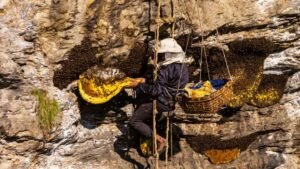
Different motivations lead people to weight these answers differently, but specific replies beat vague reassurance. As a benchmark of care, the Gurung honey hunters harvest wild honey with reverence for the bees.
No, a honey substitute is not automatically vegan, because a sweetener can be blended with other ingredients and some ingredients are processed with animal-derived materials.
Products labelled vegan or single-ingredient syrups remove the guesswork. A short list of products you have already checked saves time on every shop, and it prevents accidental purchases.
Yes, bee-free honey substitutes exist, including apple-based syrups and newer products made without bees.
Apple-based versions work in tea, smoothies and breakfast dishes. For a simple home swap, maple syrup, agave nectar, date syrup or brown rice syrup also work, with molasses and fruit syrups for variety. Agave is high fructose, so use it in moderation, while coconut nectar has a lower glycemic index and date syrup adds fiber and potassium.
Most vegans do not eat honey, because it is made by bees and counts as an animal product. A smaller group, bee-gans, eats honey sourced with minimal harm to bees.
Vegans avoid honey mainly over concerns about exploiting bees. Commercial production can involve removing the bees’ food, replacing it with sugar syrup, wing clipping and moving hives between sites.
Some vegans eat honey because they see it as a natural product from small-scale, welfare-focused beekeeping. Others cite local raw honey, personal ethics or perceived health benefits.
By the strictest definition, no, since it is still a bee product even from a small hive. Some vegans accept it when the producer follows low-harm practices, which is a personal choice.
Opinions differ. Mad honey comes from wild bees without human management, so some vegans accept it, while others see any honey harvest as exploitation.
Mad honey, from Nepal or Turkey, is made from rhododendron nectar and contains grayanotoxins, a natural neurotoxin with psychoactive effects at high doses. Regular honey does not contain these.
No. Honey production mainly supports honey bees, while wild bees are effective pollinators that make no harvestable honey, and a bee-friendly garden helps them more.
Yes, they usually do, since all three are bee products found in soaps, lip balms, candles, cosmetics and supplements.
No. Infants under 1 year should not eat honey because of the risk of botulism, which applies to all honey whether or not someone is vegan.
Maple syrup, agave nectar, coconut nectar, date syrup and brown rice syrup are common choices. Prefer single-ingredient syrups over blended products, and treat refined sugar as a separate question to check on the packet.