Real mad honey is identified by a batch-specific laboratory report that detects grayanotoxins, a code on the jar that matches that report, and an origin precise enough to be checked.
Mad honey exists because bees gather nectar from grayanotoxin-bearing rhododendron flowers, and the established producing areas are Nepal and Turkey. Anything claiming a different or unnamed source needs questions before payment.
The category attracts copycats and dishonest sellers, so the useful checks are the ones that are hard to imitate: an independent laboratory, real hive-to-jar traceability and a seller who answers plainly. Sensory clues such as color or taste can raise a doubt but never settle one, and price alone settles even less.
Real mad honey is honey that bees make from the nectar of grayanotoxin-containing rhododendron flowers, with nothing added afterwards. Those compounds are biologically active, and they are the certain characteristics that set it apart from honey gathered elsewhere.
In Nepal, wild colonies of Apis laboriosa do the foraging, while Turkish product leans on Rhododendron ponticum. Which bee species did the work is useful documentation, but only the chemistry proves anything.
Dilution is the other half of the definition. A jar stretched with sugar syrup, glucose syrup, corn syrup, rice syrup or other added sugar is no longer what its label claims, however convincing it looks.
Fake mad honey is common because rising demand meets a product buyers cannot verify by looking at a jar. Plain wildflower honey can be sold under the name, since the difference is chemical rather than visible.
Scarcity at the source makes the gap profitable, and a long supply chain gives anonymous resellers room to hide. In practice, rotating accounts that disappear and return, and listings that lean on before-and-after photos, are the patterns worth noticing.
Reputation travels through social media and word of mouth, which reward excitement over documents. Adulterated product can also carry harmful additives and unnecessary risks, so specialized online retailers that publish origin and testing details are a safer place to start.
A stated origin proves something only when it is narrowed to a district and a harvest site that someone could actually check. The established sources are Nepal and Turkey: Nepal’s wild colonies produce Himalayan cliff honey, and the Turkish version, called deli bal, comes from the Black Sea region.
Genuine sellers describe mountain villages, name the people who harvest, and tell harvest stories with places and seasons in them. “Himalayan” used as a marketing costume says nothing, and vague labels that stop at that word are a pattern, not a detail.
Many buyers hold misconceptions here, such as assuming any claim of remote mountain regions implies authenticity. Elevation alone proves nothing, because rhododendron forage is the requirement.
Harvest season and habitat matter because the flowers in bloom decide whether the honey carries rhododendron chemistry at all. The rhododendron is the botanical source, and its compounds act as a chemical defense against herbivores, which is how they reach the nectar.
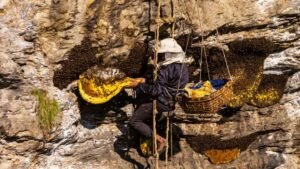
In Nepal, honey hunters climb cliffs around Lamjung and work within honey hunting communities. The labor-intensive harvesting and small annual production are why year-round supply should look suspicious.
Altitude and rainfall shape what flowers and when, and a different bee species forages in other mountain systems. Where a seller offers pollen analysis, it can confirm the botanical story, though it does not replace the grayanotoxin result.
A batch number proves that one specific jar can be linked to one specific test, and nothing beyond that. Wild honey changes between harvests, so a report that is not tied to your jar says little about your jar.
The chain should run in this order:
A consistent code is hard to fake across many jars, and small batch sizes make it realistic for honest sellers. Useful questions to ask: which harvest is this jar from, and which report covers it? Customer service that answers calmly and specifically is a good sign.
A mad honey lab report is read field by field: the laboratory, the batch, the date, the grayanotoxin result and the method used. Generic “lab tested” claims without those fields are a badge, not proof.
The date matters because a report from a previous year describes another harvest. Natural variability is large, and grayanotoxin concentrations swing considerably between batches, so a fixed pass mark deserves caution. A named method shows the result came from an established procedure.
A grayanotoxin result answers one question only. Analytical tests for purity add useful information it cannot give. Small producers may lack full reporting, so a missing report is not a verdict, and a proxy such as color is no replacement.
A transparent seller publishes what a buyer needs to check the claim without being pushed: a specific origin, a company address, clear business policies and a certificate of analysis that matches the jar.
On marketplaces, look past attractive labels. A QR code that opens the matching report is worth more than any slogan. Compare comparable products to see whether the information is consistent, and check how the seller appears across multiple platforms.
Read the ingredient list, which should say honey and nothing else. A listing with no reviews anywhere deserves a second look. In practice, the sellers who answer awkward questions fastest tend to be the ones with paperwork.
No: a high price reflects difficulty and cost, but it is not proof, because any seller can set a high number without showing anything.
Genuine mad honey is rare for real reasons: limited supply, harvests that happen twice a year in Nepal, and work done on rock faces with rope ladders. Those costs are real, and a wild product will not be cheap.
Price helps in one direction only. A jar priced like cheaper honey should raise questions, yet cost explained by sustainable harvesting, fair pay to local communities and respect for cultural heritage is not the same as authenticity.
No: color, aroma, taste and texture can raise questions, but they cannot prove that mad honey is authentic. They shift with floral source, harvest and storage, and blends or handling can imitate them.
| Clue | What changes it | Why it proves nothing |
|---|---|---|
| Color | Floral mix, season, direct sunlight in storage | Easy to imitate, and the idea that darker honey is better is a myth |
| Taste | Harvest and flavor profiles; some batches are bitter, others are not | Subjective and reproducible without grayanotoxins |
| Texture | Moisture content and room temperature | A set jar can be gently warmed to reliquefy |
Compared with regular honey, mad honey may look or taste different, yet that difference is not a test. A water test or flame test is no better, since both only hint at moisture. Laboratory results, batch traceability and verified origin remain the stronger indicators.
A label reveals a seller’s habits: honest packaging states origin, harvest details and storage advice, while mislabelled or evasive packaging hides them. A genuine jar label names the country of harvest and carries a production date, so the buyer knows which season they are holding.
Look at what the label avoids saying. Miracle-cure language is a warning sign, and so is a promise that every batch is standardised, since wild honey is not. A seller might relabel other honey or use image editing to make a jar look darker.
Undeclared additives and artificial ingredients are why adulteration testing matters when judging quality. Storage advice on the pack, such as cool dry place and tightly closed lid, also shows that the seller cares what happens after the sale.
No: home tests cannot authenticate mad honey, because the property that makes it chemically distinct can only be measured in a laboratory. Methods based on chromatography are documented for detecting grayanotoxins, and a proper report states a detection limit.
A kitchen can show viscosity, which says something about moisture and handling, nothing more. Physiological effects are not a test either. A throat sensation is not a real/fake switch, and feeling something proves nothing.
The sensible home routine is to spend 5–10 minutes on paperwork instead. Count the ticked boxes on a checklist rather than tasting the jar.
The red flags for fake mad honey are missing batch information, missing origin and missing people behind the sale. Treat counterfeit products as a pattern, in which sensational claims and hype stand in for documents.
| Signal | Real mad honey | Questionable |
|---|---|---|
| Batch | A batch identifier on the jar that matches a report | No code, or one code on everything |
| Harvest | Seasonal cliff colonies | Boxed hives, apiaries, year-round supply |
| Seller | Registered business with working contact details | No off-platform presence |
| Price | Consistent with real costs | An unexplained premium price with no documents |
| Contents | Declared and testable | Unknown substances possible |
A seller describing continuous production from managed hives is describing something other than traditional Himalayan cliff honey.
Most myths about identifying mad honey fail because they treat natural variation as a test. Color is the clearest case: genuine jars can look amber, reddish or darker, and lighting in product photos distorts all of them.
Another myth says crystallisation means fake honey. Refrigeration speeds the process, gentle warm water reverses it, and neither says anything about origin. Shelf life is a related misunderstanding: properly stored honey can last years.
A honey-soaked wick or matchstick that burns reflects moisture, not botanical source. Calling a jar ordinary wild honey or mountain honey does not separate genuine from fake either, and a medicinal edge in the taste is just one of the different expressions of a wild harvest.
Every batch of mad honey looks different because the rhododendron species in flower, the season and the site change from harvest to harvest. Honey from Myagdi and from other Himalayan districts can differ between places and between years.
In Nepal, a spring harvest and a smaller autumn harvest follow different bloom periods, so color can run from golden to dark brown. Honey from the Kaçkar Mountains in Turkey differs again.
That is why the belief in same effects every batch is a myth, and why expectations shape what people report. A tingling that appears in one jar and not the next is not a verdict. A jar that sinks or dissolves in water shows only its physical properties, such as moisture.
No: verified mad honey is not automatically safe, because authenticity and safety are separate questions. The grayanotoxins that define it are documented in the medical literature, and a verified jar still contains them.
Never rely on consuming to test a jar; feeling something is not proof. A warming sensation may or may not occur, and promises of guaranteed effects, extreme health claims or “stronger effects” messaging are red flags rather than reassurance.
Fake honey with hidden contents adds its own problems, including digestive issues, toxicity and other adverse effects. Follow the safety information supplied with the honey and speak to a qualified clinician if you have a medical condition.
Real mad honey should be stored away from heat and bright light, with the container kept shut. Follow the storage instructions from the seller, and check for tampering on arrival; sealed packaging with a broken seal is a reason to ask questions.
Heat and time change raw honey, and HMF is an indicator of heating and age, which is why overheated product is a concern. A grainy jar usually just means it has set, and temperature shifts decide how quickly. The claim that crystallized honey is fake is therefore wrong. Sensible storage keeps honey in good condition for years, so storage is rarely the reason a jar changes.
A final checklist for real mad honey covers origin, harvest timing, batch tie-in, testing, seller identity and claims, and no single feature decides it. It also helps first-time buyers turn scattered tips into informed decisions.
Behind the list sit the four conditions of authenticity: botanical source, traceable origin, grayanotoxins and no dilution. Once the jar arrives, keep it in a pantry and use a clean dry spoon.
Yes, fake mad honey can be dangerous because nobody can say what it contains. Artificial flavors and other fillers are one issue, and without contaminant screening nothing is checked. Genuine honey is no automatic safe harbor either: individual sensitivity varies, and poisonings have been reported. People with a heart condition or a blood pressure condition, anyone on prescription medication, and anyone who is pregnant or breastfeeding should speak to a qualified clinician first. Trusted sources reduce the guesswork.
No, neither is required. Some batches taste sweet with floral, herbal, earthy or even woody notes and a slightly astringent finish, while others do not, and these impressions are subjective. Describing a jar as a viral experience or promising a psychoactive kick is marketing, not authentication. The taste myth that a harsh edge proves honey is real fails, and so does the idea that it must burn. Poisonings have been reported after one to two teaspoons, so speak with a healthcare professional before trying any.
Laboratory testing is the strongest single check, but it proves authenticity only when the report is tied to your jar. A generic report covering one harvest cannot speak for others, so per-batch testing is what counts. Read the laboratory name, the test method and the units, since numbers without units mislead. DIY testing kits are less reliable than a laboratory. There is no magic sign; authenticity shows up as a pattern of consistency across origin, batch and documents.
Both come from grayanotoxin-containing rhododendron nectar, but they differ in bee, landscape and flavor. Nepal’s honey comes from the Himalayan giant honey bee, which builds open combs on rock along a mountain range, while Turkish honey comes from a different bee in a different landscape. Forest composition, foraged flowers and weather differ, as does the complex finish on the tongue. Neither is better; they are different results of the same process.
Authentic mad honey is best bought from a seller who sources directly and can document every claim. Check that origin claims name a place, and that harvests by Gurung hunters or other named teams are described concretely. Nepalese suppliers with real batch invoice records and responsive customer support are stronger choices. A named laboratory matters only when its reports are linked to batches. Read verified reviews on third-party platforms, the return policies and any educational content. Be wary of drug-like effects promises, certifications that cannot be checked, a bargain that looks too good to be true, and any unreliable source. Family-run businesses can be genuine, but they should still be able to answer plain questions.
In most countries mad honey is not a controlled substance, so buying it is generally legal, but importing it is a separate question. The risk sits at customs, where shipments without proper food labeling, certificates of origin or food safety documentation can be refused, and seized shipments do happen. Honey from Nepal reportedly has no route for commercial import into the EU or Great Britain. Check the seller’s shipping policies, understand how international shipping is handled, and prefer food-style labeling over drug-style marketing. Rules change, so verify your own country’s.